Package Architecture
The package contains classes designed to serve as modules within record linkage and deduplication pipelines, customizable to your needs and requirements. Each class demands user-supplied inputs and produces relevant outputs, some of which must be passed to other classes for additional processing.
Below are two figures illustrating standard record linkage and deduplication pipelines using Fast-ER’s classes.
Record Linkage
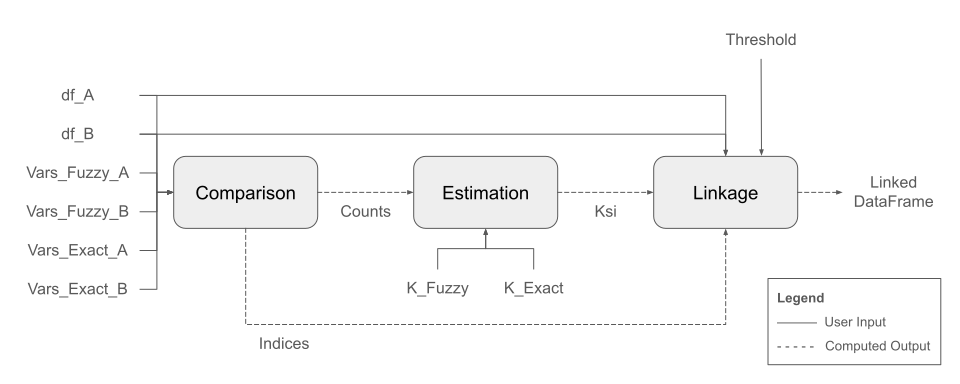
We begin by describing the record linkage pipeline. Record linkage consists of identifying matching observations in two datasets based on the similarity of their values across some variables.
The process begins by supplying the following inputs to the Comparison class: (i) two datasets (df_A and df_B), (ii) variables to compare for fuzzy matching (Vars_Fuzzy_A and Vars_Fuzzy_B), and (iii) variables to compare for exact matching (Vars_Exact_A and Vars_Exact_B). The class then compares the values of all pairs of observations in both datasets, producing an array with the frequency of each combination of discrete similarity levels across all variables stored in the Counts attribute. This array is the main input to the Estimation class, which uses it to estimate the conditional match probability for each combination of discrete similarity levels across all variables. In turn, along with the list of indices corresponding to each combination from the Comparison class, this information is the main input to the Linkage class, which generates a dataset containing all pairs of observations with a conditional match probability above a user-specified threshold.
Note
A combination of similarity levels encodes the level of similarity between the two observations in a pair across all variables being compared. It can be conceptualized as a vector in which each element reflects the pair’s discrete level of similarity over a given variable.
Deduplication
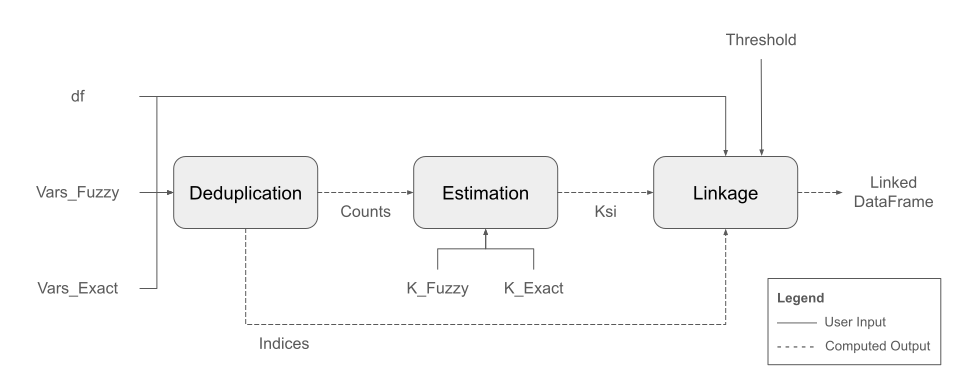
Next, we describe the deduplication pipeline. The objective of deduplication is to identify matching observations in a single dataset based on the similarity of their values across some variables.
The process begins by supplying the following inputs to the Deduplication class: (i) a dataset (df), (ii) variables to compare for fuzzy matching (Vars_Fuzzy), and (iii) variables to compare for exact matching (Vars_Exact). The class then compares the values of all pairs of observations in the dataset, producing an array with the frequency of each combination of discrete similarity levels across all variables stored in the Counts attribute. This array is the main input to the Estimation class, which uses it to estimate the conditional match probability for each combination of discrete similarity levels across all variables. In turn, along with the list of indices corresponding to each combination from the Deduplication class, this information is the main input to the Linkage class, which generates a dataset containing all pairs of observations with a conditional match probability above a user-specified threshold.